

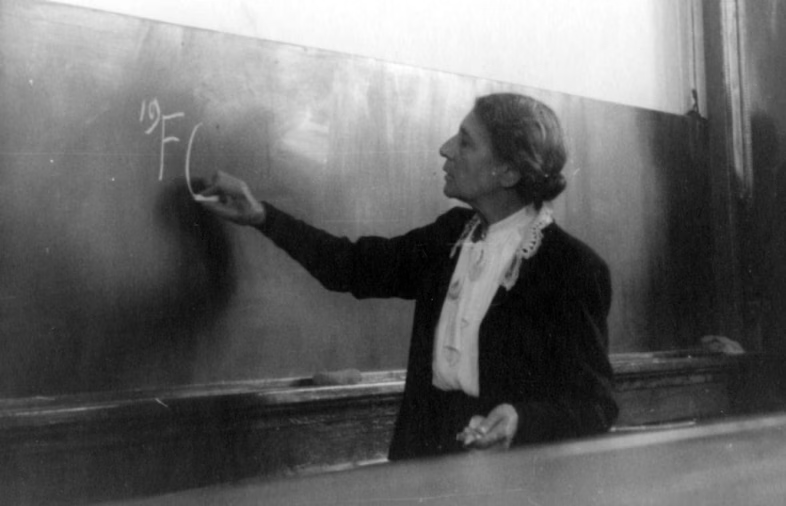
The theory of Lise Meitner
By Mathéo Girardin Tarby
Published the 22/10/2025 à 13h00
How a simple analogy revealed one of the most powerful secrets of matter
Imagine the heart of an atom: a tiny, dense, and already a bit unstable nucleus. What happens if an even smaller particle hits it? In 1938, Lise Meitner, an Austrian physicist in exile, answered this question with a rare scientific elegance. His discovery of nuclear fission has revolutionized physics... and the world.
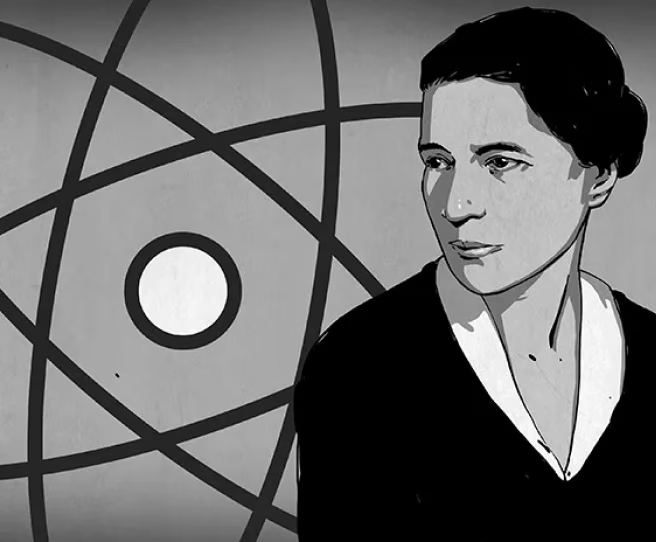
Vector image of Lise Meitner
The nucleus, a drop ready to burst
To make fission understandable, Meitner and her nephew Otto Frisch had a brilliant idea: to compare the atomic nucleus to a drop of water. Take uranium, a heavy element. Its core is like a big drop under tension. When a neutron - a neutral particle - hits it, it’s as if we were shaking that drop. It deforms, stretches... and ends up breaking.
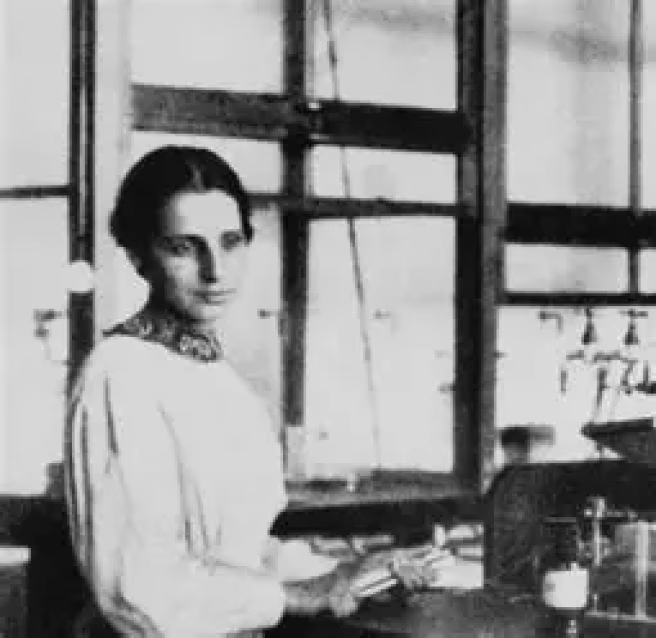
Picture of Lise Meitner in her laboratory
A break that releases colossal energy
The cleavage of the nucleus produces two smaller nuclei, several neutrons, and a phenomenal amount of energy. It is this phenomenon that Meitner named 'nuclear fission'. She calculated the energy released, confirming Einstein’s famous equation: E = mc².
"Nuclear fission is the division of a heavy atomic nucleus into two lighter nuclei."Définition vulgarisée
A chain reaction with multiple uses
The released neutrons can strike other nuclei, triggering a chain reaction. This principle is at the heart of nuclear power plants, where energy is controlled to produce electricity. It is also used in medicine, in industry... and unfortunately, in weaponry. Meitner, true to his convictions, has always refused to participate in the Manhattan project. Thanks to Lise Meitner, a complex process has become intelligible. Her pedagogy and rigor have allowed nuclear physics to take a step forward... and it’s up to each of us to understand the basics.