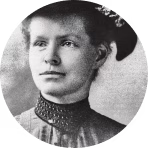
Nettie Stevens (1861–1912)
She demonstrated that sex is determined by chromosomes, but her colleague Thomas Hunt Morgan has been more recognized for similar works.



They discovered, invented, calculated, experienced... but for a long time, they were not told. The women scientists have been the great absentees from literature, relegated to secondary or erased roles of the story. Today, things are changing: fiction finally seizes their destinies, and gives them the place that they deserve.
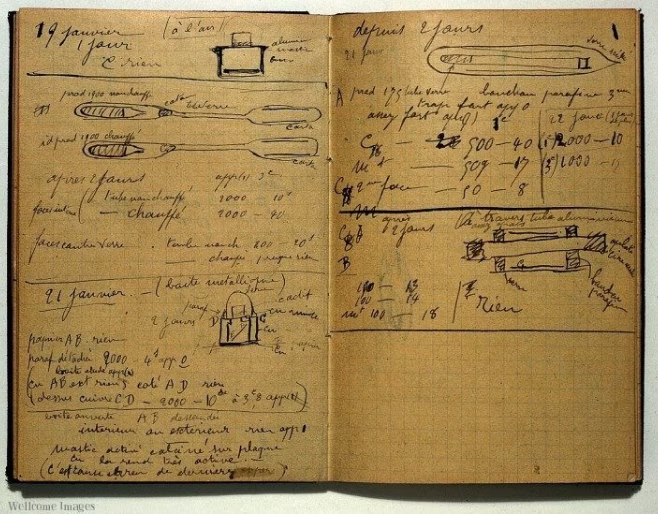
For centuries, literature has staged scholars, researchers, geniuses... almost always masculine. Women in science, they were invisible or confined to roles of assistants, muses or curiosities. This narrative silence reflects a broader erasure, that of their place in the history of science.
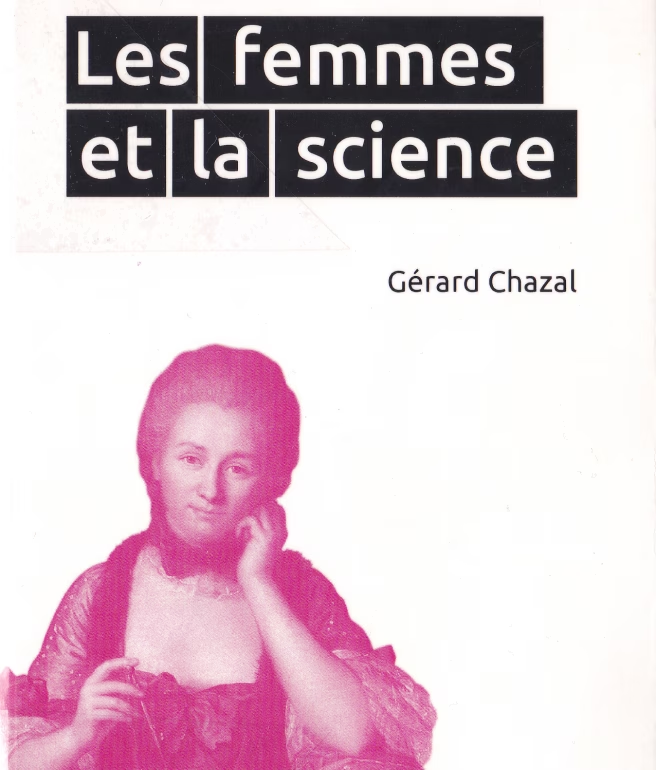
For a few years, authors and authors have been working to revive these forgotten figures. Novels like Radium Girls by Kate Moore or The woman who decided to switch to daylight saving time by Bérengère Cournut put in light of the researchers, laboratory workers, pioneers. Fiction then becomes a tool for memorial justice, in giving back flesh and voice to those whom the textbooks have neglected.
Telling the story of women scientists also means broadening our imagination of knowledge.These narratives are not only historical reparations. They are also stepping stones for the future. In showing women passionate about science, literature offers young readers - and readers - models powerful, capable of inspiring vocations. It participates in a reconfiguration of the intellectual landscape, where the genius no longer has of gender.

She demonstrated that sex is determined by chromosomes, but her colleague Thomas Hunt Morgan has been more recognized for similar works.
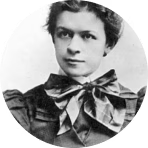
First wife of Albert Einstein, she would have contributed to the work on relativity, but her role remains controversial and largely ignored.
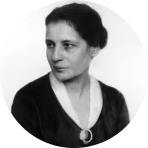
Co-discoverer of nuclear fission, her colleague Otto Hahn received the Nobel Prize alone from chemistry in 1944.
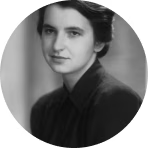
Pioneer in X-ray diffraction imaging, her work was crucial for the discovery of the double helix of DNA, but the credit went to Watson, Crick and Wilkins.

She discovered the lambda phage and developed bacterial replication techniques, but her husband Joshua Lederberg received the Nobel alone.
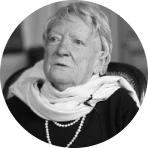
She identified the supernumerary chromosome responsible for trisomy 21, but her colleague Jérôme Lejeune was credited alone.

Doctoral student, she discovered the first pulsars in 1967. Her thesis director has received the Nobel prize, she was ignored.